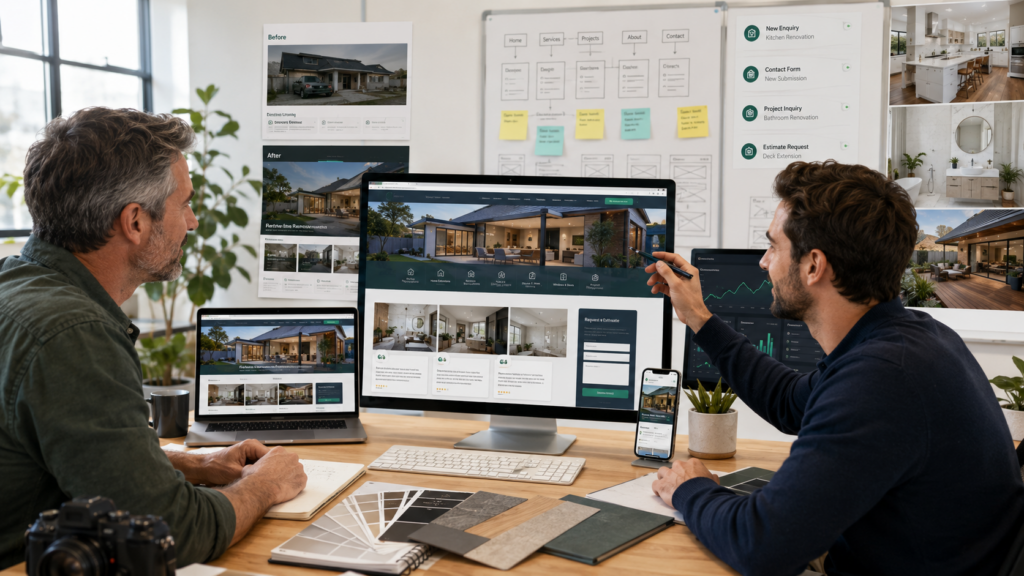
A contractor’s website must do more than display attractive project photographs. It needs to explain the services clearly, establish trust quickly, work reliably on mobile devices, and make requesting an estimate feel straightforward.
This anonymized case study explains how a complete WordPress redesign helped a local home improvement contractor replace an outdated website with a faster, clearer, and more conversion-focused digital platform.
Client Overview
The client is an established local contractor providing residential improvement and renovation services within a defined service area.
Most previous business came through referrals, repeat customers, local advertising, and directory listings. Although the company had a website, it did not accurately represent the quality of its work or provide a dependable path for generating new enquiries.
The project objective was not simply to modernize the visual design. The new website needed to support trust, search visibility, mobile usability, lead generation, and future content growth.
The Challenge
The existing website had several connected issues affecting both customer experience and marketing performance.
An Outdated First Impression
The website used an old layout, inconsistent typography, small images, and weak visual hierarchy. Visitors could not quickly determine which services the contractor provided or what made the business different from competing providers.
For a service involving access to a customer’s home and a significant financial decision, that lack of clarity weakened trust before a conversation began.
Confusing Service Architecture
Multiple services were grouped together on broad pages. Important service details were buried inside long sections, and the navigation did not reflect how prospective customers researched individual projects.
This created problems for both users and search engines:
- Visitors struggled to find information relevant to their project.
- Individual services lacked dedicated search targets.
- Internal links did not establish a clear content hierarchy.
- Calls to action appeared without enough supporting context.
Poor Mobile Performance
A large proportion of prospective customers visited the website from mobile devices, but the existing experience was slow and difficult to navigate.
Oversized images, unnecessary scripts, unstable layouts, and small interactive controls increased loading time and made important pages harder to use.
Trust Signals Were Difficult to Find
The contractor had genuine project experience and positive customer feedback, but much of that proof was disconnected from the relevant services.
Testimonials, project photographs, service-area information, process details, and business credentials were not positioned where visitors needed reassurance.
Unclear Enquiry Journey
The website used inconsistent buttons and a lengthy contact form. Visitors were asked for too much information before receiving a clear explanation of what would happen next.
Telephone clicks, form completions, and lead sources were not tracked reliably, preventing the business from measuring the website’s contribution to new opportunities.
Project Goals
The redesign was planned around six practical goals:
- Create a credible and modern visual identity.
- Make important services easier to find and understand.
- Improve mobile speed and usability.
- Place relevant proof near customer decisions.
- Simplify the estimate-request journey.
- Provide a flexible WordPress system the business could maintain.
Phase 1: Discovery and Conversion Audit
We began by reviewing the existing website, traffic patterns, enquiry process, service priorities, customer questions, competitors, and available proof.
The audit examined:
- Navigation and page architecture.
- Mobile usability.
- Loading performance.
- Service-page depth.
- Calls to action.
- Contact-form friction.
- Testimonials and project evidence.
- Technical SEO fundamentals.
- Analytics and conversion tracking.
Findings were organized by business impact. Issues affecting service discovery, trust, mobile usability, and enquiries were addressed before minor decorative improvements.
Phase 2: Website Architecture
The new structure was designed around the contractor’s principal services and the questions customers asked before requesting an estimate.
Each priority service received a dedicated page containing:
- A clear service-specific headline.
- Common customer needs and project types.
- A description of the contractor’s process.
- Relevant photographs and proof.
- Frequently asked questions.
- Service-area context.
- A focused estimate-request call to action.
Related services were connected through contextual internal links instead of relying exclusively on the main navigation.
Phase 3: Conversion-Focused Design
The new design used stronger hierarchy, clearer spacing, readable typography, and consistent calls to action. The goal was to communicate professionalism without making the website feel like a generic corporate template.
The homepage was reorganized to answer five immediate questions:
- What does the contractor do?
- Where does the business operate?
- What type of customer or project does it serve?
- Why should visitors trust the company?
- How can someone request an estimate?
Important actions remained visible without relying on intrusive pop-ups. Buttons used consistent language so visitors always understood what would happen next.
Phase 4: Trust and Project Proof
Proof was integrated throughout the customer journey rather than isolated on a single gallery or testimonial page.
Relevant service pages included:
- Project photography.
- Customer testimonials.
- Process explanations.
- Service standards.
- Frequently asked questions.
- Clear service-area information.
This gave visitors evidence at the moment they were comparing providers and deciding whether to make contact.
Phase 5: WordPress Development
The approved layouts were implemented as a responsive WordPress website using reusable content components.
The system allowed the business to update services, project examples, testimonials, FAQs, and general page content without rebuilding templates.
Development priorities included:
- Clean responsive layouts.
- Predictable content editing.
- Accessible navigation and forms.
- Stable dimensions to reduce layout movement.
- Minimal reliance on unnecessary plugins.
- Secure form handling.
- Search-friendly HTML structure.
Phase 6: Mobile Performance Optimization
Performance work focused on the experience of real prospective customers using mobile connections.
Improvements included:
- Resizing and compressing project photographs.
- Serving suitable image dimensions.
- Lazy-loading media below the first viewport.
- Reducing unnecessary scripts and styles.
- Preloading important local fonts and visual assets.
- Defining image dimensions to prevent layout shifts.
- Testing key pages under mobile network conditions.
Visual quality was preserved while reducing the amount of data required to load important pages.
Phase 7: Lead Capture and Tracking
The estimate-request form was shortened and reorganized around the information needed for an initial response.
Visitors were asked for essential contact details, the service required, project context, and preferred timing. Additional details could be collected during the consultation rather than creating unnecessary form friction.
Tracking was configured for:
- Completed enquiry forms.
- Telephone-link clicks.
- Consultation-button clicks.
- Important service-page visits.
- Campaign and referral sources.
- Confirmation-page visits.
This gave the contractor a clearer view of how website visits became sales opportunities.
Testing and Launch
Before launch, the website was tested across common mobile and desktop viewport sizes, modern browsers, forms, navigation paths, and conversion actions.
The launch checklist included:
- Redirecting replaced URLs.
- Checking titles and meta descriptions.
- Validating sitemap and indexing settings.
- Testing forms and notification emails.
- Checking analytics and conversion events.
- Reviewing image alternative text.
- Testing keyboard navigation.
- Checking broken links and error pages.
The Results
During the agreed measurement period, the redesigned website improved both usability and lead-generation performance.
- Completed enquiry forms increased by +87%.
- The mobile conversion rate increased by +64%.
- Mobile loading time decreased by -46%.
- Visits to priority service pages increased by +58%.
- The mobile performance score reached 92/100.
The strongest improvement was not a single performance score. The website gave prospective customers a clearer path from discovering a service to reviewing proof and requesting an estimate.
Why the Redesign Worked
The project succeeded because visual design, content, speed, trust, SEO, and conversion tracking were planned as one system.
A cosmetic redesign alone would not have solved unclear service architecture or weak lead tracking. Likewise, technical optimization would have produced limited business value if visitors still could not understand the offer.
The new website aligned presentation and functionality with the way real customers evaluated the contractor.
Key Lessons for Contractor Websites
- Give commercially important services dedicated pages.
- Design for mobile customers from the beginning.
- Place proof beside relevant services and calls to action.
- Keep enquiry forms short enough to complete comfortably.
- Explain what happens after someone requests an estimate.
- Track calls, forms, and lead sources rather than traffic alone.
- Use a content system the internal team can maintain.
Planning a Contractor Website Redesign?
Slay That Site builds conversion-focused WordPress websites for service businesses that need clearer positioning, stronger search foundations, and more reliable enquiry paths.
Explore our WordPress web development service and lead generation service to understand how we connect website quality with business growth.
You can also review our other case studies for additional project examples.
Book a free consultation to discuss your current website and the improvements that would create the greatest practical value.