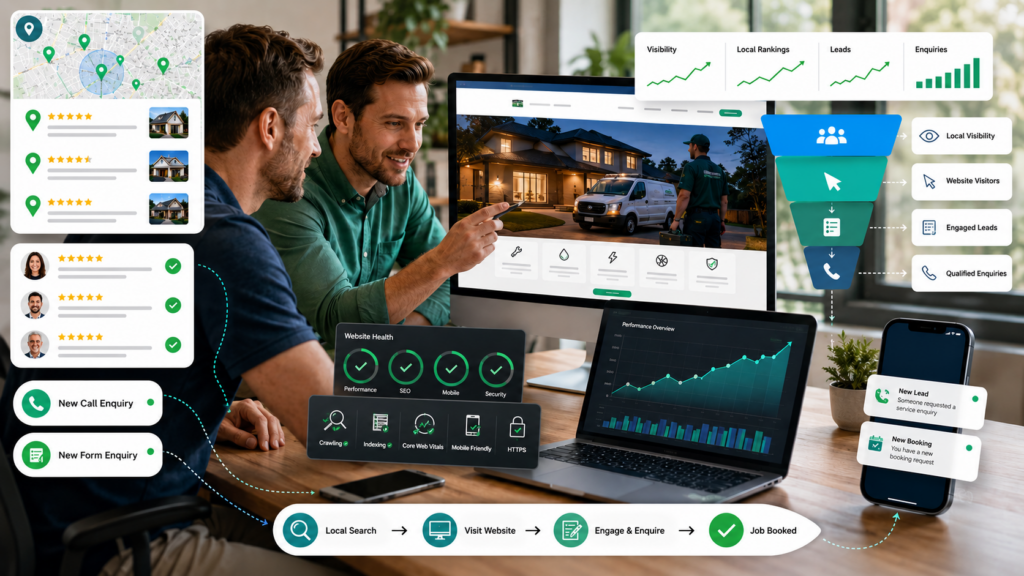
A strong local service business can still struggle online when its website is difficult to find, unclear to visitors, or unable to track enquiries properly.
This anonymized case study explains how a coordinated local SEO and website conversion strategy helped an established home services business improve its organic visibility and generate more qualified enquiries.
Client Overview
The client provides residential home services within a defined local service area. The business had a positive offline reputation and received regular referrals, but its digital presence did not reflect the quality of its work.
The website contained basic information about the company and its services, yet it was not structured around the way potential customers searched. Paid advertising generated some enquiries, but rising costs made the business increasingly dependent on campaigns that stopped producing leads as soon as spending paused.
The Challenge
The project began with four connected challenges: weak local search visibility, underdeveloped service pages, limited conversion proof, and incomplete tracking.
Limited Visibility for High-Intent Searches
The website appeared for branded searches but had limited visibility when potential customers searched for specific services in the local area. Several important pages used broad wording that did not clearly match customer search intent.
Search engines also received inconsistent signals about the services offered and the geographic area served.
Weak Service Pages
Most service pages contained only short descriptions. They did not sufficiently explain:
- Which problems the service solved.
- Who the service was suitable for.
- What the working process involved.
- Why customers should trust the business.
- Which action visitors should take next.
This limited both ranking potential and conversion performance.
Insufficient Trust Near Key Decisions
The business had positive customer feedback, but testimonials and proof were not positioned near service descriptions and enquiry calls to action.
Visitors had to search through the website to understand the company’s experience, service standards, and previous results.
Incomplete Lead Tracking
The existing analytics setup measured visits but did not reliably identify completed enquiry forms, telephone clicks, booking actions, or the original source of each lead.
Without that information, the business could not confidently determine which pages or marketing channels were producing valuable opportunities.
Our Strategy
We built the project around three priorities:
- Make the website technically accessible and understandable to search engines.
- Create stronger pages for high-intent local service searches.
- Make it easier to trust the business and submit an enquiry.
Phase 1: Technical SEO Foundation
We completed a technical audit covering crawlability, indexing, page status codes, metadata, canonical URLs, sitemap configuration, mobile usability, structured data, and loading performance.
The highest-impact issues were prioritized first. This prevented the project from becoming an unfocused checklist of minor recommendations.
Technical improvements included:
- Removing broken internal links and unnecessary redirects.
- Correcting indexation and canonical inconsistencies.
- Improving page titles and meta descriptions.
- Compressing oversized images.
- Improving mobile loading performance.
- Adding appropriate LocalBusiness and Service schema.
- Clarifying sitemap and robots.txt directives.
These changes created a cleaner foundation for the content and local SEO work that followed.
Phase 2: Local Keyword and Competitor Research
Keyword research focused on searches that showed clear service intent rather than broad informational traffic.
We grouped searches by:
- Primary service.
- Customer problem.
- Urgency.
- Location.
- Commercial intent.
Local competitors were reviewed to understand content gaps, service positioning, trust signals, reviews, page structure, and search-result presentation.
This research informed the new website architecture and prevented multiple pages from competing for the same keyword theme.
Phase 3: Service-Page Improvements
The most commercially important service pages were rewritten and expanded. Each page was designed to answer the questions a potential customer would normally ask before contacting the business.
The revised pages included:
- A clear service-specific headline.
- Common customer problems and warning signs.
- An explanation of the service process.
- What was included.
- Relevant proof and testimonials.
- Service-area information.
- Frequently asked questions.
- A clear enquiry call to action.
Internal links connected relevant services, supporting articles, contact pages, and proof content. This helped visitors continue their research while providing search engines with a clearer understanding of the website’s structure.
Phase 4: Google Business Profile and Local Signals
The Google Business Profile was reviewed for category selection, service descriptions, contact information, images, service areas, and website links.
Business information was standardized across important online references. The client also introduced a consistent process for requesting genuine customer reviews after completed work.
Location language was used naturally throughout the website. We avoided producing thin pages for locations where the business did not have meaningful experience or service coverage.
Phase 5: Trust and Conversion Improvements
Increasing traffic would have had limited value if visitors still lacked confidence in the business.
We moved relevant testimonials, service guarantees, process information, and result evidence closer to important calls to action. Contact options were simplified and made consistent across desktop and mobile devices.
The enquiry form was shortened to request only the information needed for an initial response. Clear confirmation messaging explained what would happen after submission.
These improvements reduced uncertainty without relying on aggressive pop-ups or exaggerated claims.
Phase 6: Analytics and Lead Tracking
Conversion tracking was configured for important actions, including:
- Completed enquiry forms.
- Telephone link clicks.
- WhatsApp or messaging clicks.
- Booking actions.
- Visits to confirmation pages.
- Campaign and referral sources.
This allowed the business to evaluate SEO performance using qualified enquiries rather than traffic alone.
The Results
Over the six-month measurement period, the website achieved measurable improvements across organic visibility, local discovery, and lead generation.
- Organic search traffic increased by +184%.
- Qualified website enquiries increased by +126%.
- Google Business Profile actions increased by +73%.
- The primary service pages reached a conversion rate of 4.8%.
- 18 priority service keywords reached the local top ten.
More importantly, the business became less dependent on untracked referrals and short-term advertising. The improved website created a clearer path from local search to qualified enquiry.
Why the Strategy Worked
The project succeeded because technical SEO, content, local visibility, trust, and conversion tracking were treated as parts of the same customer journey.
Ranking improvements alone would not have solved weak conversion performance. Likewise, a better-looking website would not have generated consistent opportunities without relevant search visibility.
The combined strategy helped the right people find the business, understand its services, trust its experience, and take the next step.
Key Lessons for Local Service Businesses
- Prioritize commercially important service pages before publishing large volumes of blog content.
- Use location information naturally and only where the business genuinely operates.
- Place testimonials and proof close to service decisions and calls to action.
- Track completed enquiries and source data, not just website visits.
- Fix high-impact technical problems before pursuing minor SEO scores.
- Connect SEO and conversion work instead of treating them as separate projects.
Build a More Reliable Local Lead System
Slay That Site helps service businesses improve the complete journey from search visibility to qualified enquiry.
Explore our SEO services and lead generation services to see how we approach sustainable growth.
Book a free consultation to discuss the highest-impact improvements for your website.